Section 1: The Moment I Knew Something Was Different
There’s a stretch of field behind my house where the evenings unfold in soft layers — golden light on tall grass, the rustle of leaves, and the steady rhythm of white-tails stepping out of the woods like clockwork. It’s the kind of place where a part albino deer sighting feels almost impossible, yet I’ve spent countless hours watching these deer drift through my backyard, much like the quiet mornings I spend along the river watching eagles and learning to notice the wild close to home.
For a while, I kept catching a flicker of pale movement at the edge of the woods. At first I brushed it off — maybe just the sun catching a flank, or maybe my eyes playing tricks after writing so much about patience in wildlife photography. But the shape felt different, lighter, almost ghost-like.
So I started watching more intentionally. Every evening. Most mornings. Coffee in hand, camera nearby, doing that thing photographers do where you pretend you’re “just checking,” but inside you know you’re officially on a mission.
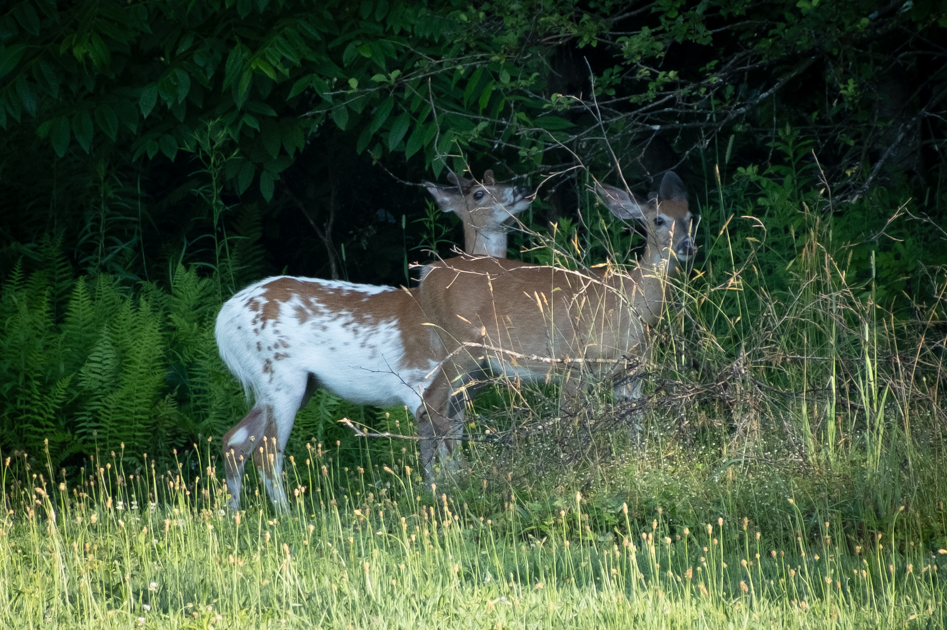
And then, one soft evening, it happened. The herd shifted, the shadows opened, and there it was — a part-albino deer stepping into the field, its white patches glowing against the dusk. For a moment, even the birds went quiet.
It was the kind of unexpected encounter that reminds me why I love wildlife moments on the back roads — the extraordinary hiding in the ordinary, waiting for us to notice.
Section 2: The Search — A Week of Watching and Wondering
Once I realized I wasn’t imagining that flash of white, the whole rhythm of my days shifted. I started planning my mornings the way I do when I’m out on the road photographing wildlife — quietly, intentionally, always leaving room for the unexpected.
Every day, just after sunrise, the field would come alive. A few does would step out first, ears flicking, then the younger deer would follow, grazing their way across the grass before melting back into the woods. I’d watch from my back window or the edge of the yard, trying to stay as still as possible. It reminded me how much patience shapes good wildlife photography; sometimes the waiting is longer than the moment itself.
By evening, I’d be out there again. The light turns soft and golden at the back of my property, the kind that makes even ordinary moments look cinematic. I’d scan the tree line, hoping for the pale shape to appear. Some nights I’d think I saw it, only to realize it was just a fawn catching the last bit of sun. Other nights… nothing at all.
Wildlife doesn’t happen on schedule
But that’s the thing about wildlife — the best sightings rarely happen on our schedule. They come when you’ve settled into the moment, when you’re paying attention, when you’ve taken the time to understand the rhythm of a place. It’s the same lesson I’ve learned again and again while photographing back-road wildlife across America: if you show up often enough, nature eventually reveals what it wants you to see.
And so, for a week, I watched and waited. Not obsessively — just with a kind of quiet curiosity. I wasn’t even sure I’d be able to photograph the deer if it appeared. I only hoped I’d get a second chance to confirm what I thought I saw.
Eventually, that chance came.
Section 3: Finally Seeing It — The Moment the Part-Albino Deer Stepped Into View
It happened on a quiet evening, the kind where the light softens early and the whole field turns the color of warm honey. The regular herd stepped out first, moving with that easy confidence deer have when they know the routine better than we do. I was watching their familiar shapes drift through the grass when something lighter shifted behind them.
At first, I thought it was just a trick of the light — the same doubt I’d carried all week. But then the deer moved again, and there was no mistaking it. A white patch along the its back. The unmistakable glow of something rare stepping out of the shadows.
A part-albino deer.
For a moment I just watched
For a moment, I forgot I was standing there with a camera. I just watched, the way I do when an eagle glides over the river and I feel that stillness settle in. The deer’s white markings caught the last of the sun, making it look almost luminous. It wasn’t a full albino — not the all-white coat and pink eyes you sometimes hear about — but a partial one, a piebald pattern that’s far less common. Researchers estimate that piebald deer appear in less than one percent of the population, and even then, most people never see one in the wild.
Seeing it in my own backyard felt like being let in on a secret.
Section 4: How Rare These Deer Really Are — And Why This Sighting Matters
Most people go their entire lives without seeing a deer like this. Partial-albino and piebald deer make up only a tiny fraction of the population — often well under one percent. Their unique coloring is caused by a genetic condition that affects pigmentation, creating those unmistakable white patches that almost glow against a normal brown coat.
Because they’re so rare, sightings tend to become local legends. Hunters talk about them with a mix of awe and superstition. Wildlife biologists study them carefully. And photographers — well, we basically turn into quiet detectives, slipping into the same curiosity and patience we rely on when photographing elusive wildlife on the back roads.
What makes them even harder to spot is their behavior. These deer stay with their herds but often linger at the edges, moving cautiously. Their white patches can make them more visible to predators, so they’re naturally more wary. Which means that catching even a glimpse — let alone getting a single photograph — feels like a gift.
Seeing one in my own backyard reminded me how much of the wild lives right beside us, even when we’re not looking. It’s the same truth that shapes so many of my favorite encounters close to home: if you slow down, pay attention, and let nature set the pace, you’ll find the extraordinary hiding in familiar places.
That’s why this one moment stayed with me. It wasn’t just rare — it felt personal. As if the field, the woods, and the quiet rhythm of this little corner of New York had decided to reveal something special for anyone patient enough to wait.
Section 5: The Photograph — Capturing the Moment Before It Vanished
When the deer finally stepped fully into the open, instinct took over. I eased the camera up slowly — the same careful motion I’ve practiced countless times while photographing wildlife along quiet rivers and forest edges. Even though I’ve spent years learning to anticipate moments like this, nothing prepares you for the mix of excitement and stillness that comes when something rare is unfolding right in front of you.
The deer paused just long enough. Its white patches caught the light, glowing softly against the darker tones of the field. The rest of the herd moved around it, perfectly ordinary in every way, as if they had no idea they were escorting one of the rarest animals in the area.
I pressed the shutter once.
Just one frame.
There wasn’t time for a second. A shift in the herd sent them moving again, and in a blink the pale patches disappeared back into the trees. The field returned to its familiar quiet, as if the moment had imagined itself and then slipped away.
Later, when I opened the image on my screen, it struck me how much a single photograph can hold — proof, yes, but also a story. It looked different from the dramatic wildlife photos I take when I’m traveling or working with long lenses in big landscapes. This one felt closer, more intimate, like a quiet reminder that sometimes the most meaningful encounters happen right where we live.
It also reinforced something I’ve learned again and again: you don’t need a perfect setup, a grand location, or a long lens to have a memorable wildlife experience. Sometimes all you need is attention, patience, and a willingness to look for the extraordinary in ordinary places. And we need to give wildlife space. It is their home. You can read more in my post Ethics and Respect for Wildlife.
Section 6: What This Encounter Taught Me — Patience, Curiosity, and the Wild at Home
That single sighting stayed with me long after the deer slipped back into the woods. It reminded me how much of the wild exists right alongside us, even when we’re rushing through our days. I spend so much of my time exploring national parks, back roads, and scenic byways, always searching for wildlife in dramatic places. But this encounter brought me back to something I’ve learned many times: the wild doesn’t always wait for us out on the road — sometimes it finds us right at home.
Waiting for that deer taught me the same kind of patience I rely on when I’m photographing eagles along the river or watching for quiet wildlife moments while traveling. It wasn’t about the perfect shot. Or about proof. It was about showing up day after day, paying attention, and letting curiosity guide the process.
It’s important to slow down
It also reminded me how important it is to slow down. When I’m traveling, I talk a lot about moving with intention — taking time to notice the light, the rhythm of a place, the stories unfolding around you. That same mindset works just as well in a backyard as it does in a national park. The more you look, the more you see.
And maybe that’s the real gift of this little encounter. Not just the rare genetic pattern or the fact that I happened to catch it on camera, but the way it encouraged me to look a little closer at my own corner of the world. To pay attention to the familiar paths through the grass. And to appreciate the quiet moments at dawn and dusk. To remember that extraordinary wildlife experiences don’t always come with mountains, long hikes, or perfect timing.
Sometimes they walk out of the woods when you least expect it, carrying just enough mystery to make you fall in love with the wild all over again.
Conclusion: A Quiet Reminder From the Wild
Seeing that part-albino deer wasn’t dramatic or loud. It didn’t come with a perfect pose or a once-in-a-lifetime photograph. The moment was quieter than that — the kind of moment that slips in softly, stays just long enough, and leaves you with a renewed sense of wonder.
It reminded me why I keep my camera close, why I pay attention to the edges of fields and the movement of shadows, and why I’m always drawn to the small, unexpected moments nature offers when we slow down long enough to notice. Whether I’m standing along a river watching eagles, wandering through hidden back roads, or simply looking out my own window, the wild has a way of rewarding curiosity.
And sometimes, like on this ordinary evening in my backyard, it offers something truly rare.
Explore More
If this rare deer sighting spoke to you, here are a few posts that echo the same themes of patience, curiosity, and noticing the wild right where you are:
- Finding the Wild Close to Home: Photographing Bald Eagles Near My Backyard
- Wildlife Encounters on America’s Back Roads
- Mastering the Art of Wildlife Photography
- Mastering the Art of Patience in Wildlife Photography
- Finding Creativity in the Everyday
- Ethics and Respect for Wildlife
Each of these dives deeper into the quiet, meaningful moments nature offers — whether you’re wandering far from home or simply looking out your back window.
If you enjoy stories like this, you’ll love my free travel and photography newsletter — filled with tips, behind-the-scenes moments, and inspiration from the road. Join here.